Fuel
What a fuel audit actually finds
Three months of card data, a tape measure and a lot of patience. Here is what tends to turn up when fuel is reconciled against kilometres.
FLEETIQ Advisory Team 2 min read
The request usually arrives the same way. Fuel spend is up twenty percent on last year, the finance director wants to know why, and the transport manager blames the pump price. Sometimes that really is the whole story. Usually it isn't.
Start with the tank, not the receipt
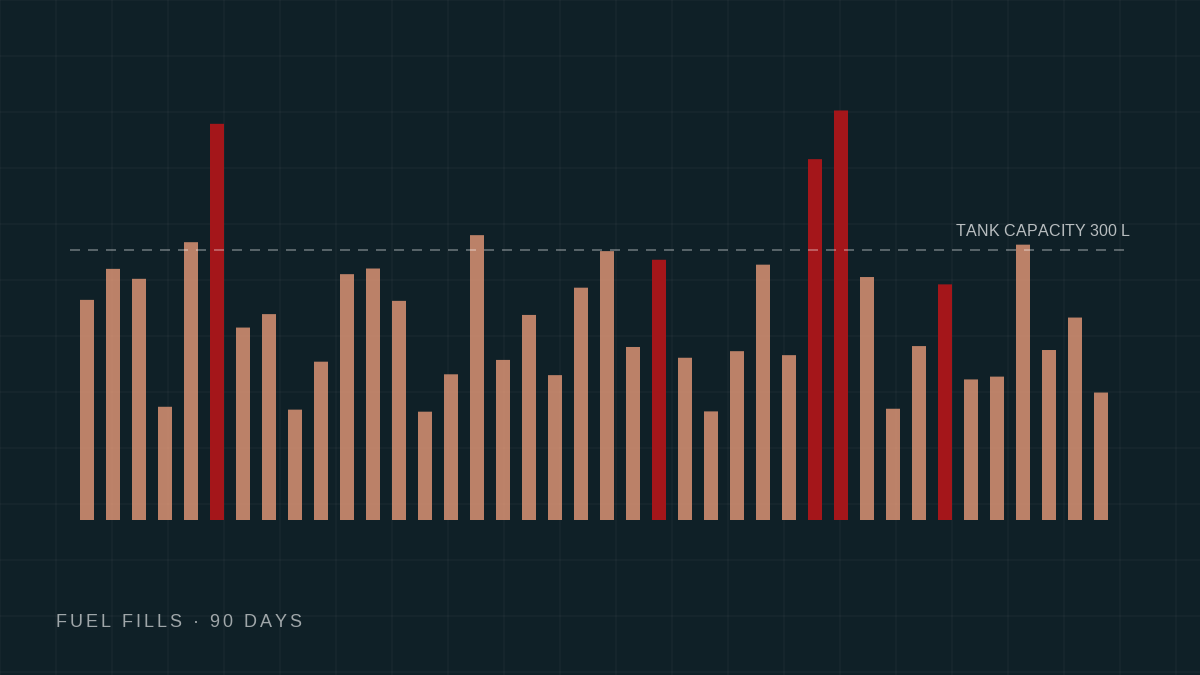
Every vehicle has a tank capacity printed in its manual. It sounds too obvious to matter, but the first thing we do is check every fill in the period against it. A 300-litre tank cannot take 380 litres in one go. When it does on paper, either the record is wrong or the fuel went somewhere else: a jerrycan, a generator, another vehicle.
A small number of vehicles tend to account for most of the oversized fills. That is good news. It means the problem is specific and fixable rather than a vague culture issue.
Then line it up against the tracker
If the fleet has GPS, we match the time and place of each fill against where the vehicle actually was. A fill recorded in Ikeja while the truck sat in Onitsha gets flagged. So does a 2 a.m. fill on a vehicle that never runs at night.
Without trackers we fall back on odometer readings and trip logs. Slower, less precise, but distance driven against litres bought still exposes the outliers.
Consumption tells you about the driver
Not every missing litre was stolen. Idling eats a remarkable amount of diesel; a truck left running with the air-conditioning on at a loading bay can burn a few litres every hour. Harsh acceleration, overloading and soft tyres all push litres per 100 km up as well.
So we separate the two problems. Theft and leakage get a control fix: cards, limits, reconciliation, consequences. Behaviour gets a coaching fix: scorecards, idling targets, training.
What changes afterwards
The fixes are rarely glamorous. A weekly exception report that someone actually reads. Fuel cards with per-vehicle limits. A rule that any fill above 95% of tank capacity gets a phone call. A driver league table pinned up in the canteen.
None of it needs expensive technology. It needs one person to own the number, and a baseline to measure against. That is what the audit gives you.
Curious where your fleet stands? The Fleet IQ-Check takes about four minutes.